Lots of things online feel loud. This quiz feels simple. It asks how you say common words. Then it builds a map that may point close to where you grew up.
People often call it the New York Times “Where Are You From” quiz. Its real title is “How Y’all, Youse and You Guys Talk.” The quiz became famous because it turns small language habits into a personal map.
What the NYT dialect quiz really does
This is not a DNA test. It does not read your phone location. It is a dialect quiz.
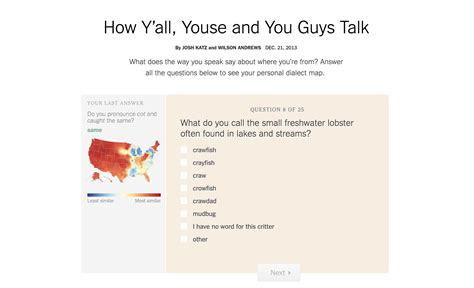
A dialect is the way a group of people uses language. It can include word choice, grammar, and pronunciation. The quiz looks at those clues and compares them with regional patterns.
You answer questions about words you use in daily life. Some ask what you call an object. Others ask how you say a word. The quiz then builds a map of places where people gave similar answers.
At the end, you may also see cities that match your answers well. That does not prove you are from one of those cities. It only means your answers fit speech patterns found there.
Why small words can reveal a region
We learn much of our speech when we are young. Family, school, friends, and local culture all shape the words we use.
Think about simple choices. Do you say soda, pop, or coke? Do you call athletic shoes sneakers or tennis shoes? Do you say y’all, you guys, or something else?
These words feel ordinary. Yet they can be strong regional clues.
That is why the quiz can feel so accurate. It is not reading your mind. It is matching your answers with patterns found in survey data.
Where the quiz came from
The New York Times quiz grew from earlier dialect research. Many of its questions were based on the Harvard Dialect Survey, a large project that asked Americans how they used and pronounced common words.
The Times later gathered a large set of its own answers and used them to build the interactive map. Josh Katz, then a graphics editor at The New York Times, created the project.
The original New York Times dialect quiz is still the best source for seeing how the project works.
What the map colors mean
The map is easy to overread. Darker or stronger colors do not mean your speech is better or more correct.
They show where your answers are a closer match to local speech patterns.
The map is also not a birth record. You may have moved. Your parents may have grown up somewhere else. You may use words from more than one region.
In other words, the map shows a language match. It does not prove where you were born or where you live now.
Why you may get a different result on another try
The quiz can give you a different mix of questions on another run. That can change the final map.
Some words are stronger clues than others. A question about a very regional word may pull your result toward one area. A more common word may add little.
So one run can lean toward one city while another run points a little farther away.
How family and moving can change your result
Speech travels with people.
If your parents grew up in another state, you may use words from their home region. If you moved as a child, your speech may blend two places. If you have lived in several cities, you may pick up new terms over time.
Many people also code-switch. That means we change how we speak based on the setting. We may talk one way with family and another way at work.
A quiz has to turn all of that into one map. It will never be perfect.
The internet also mixes language faster than it once did. Viral phrases can jump from one region to the whole country in days. That is one reason older regional lines may feel less sharp for some younger speakers.
How to get a cleaner result
- Answer with the words you really use. Do not try to guess which answer belongs to your hometown.
- Think about the language you used as a child. Those early habits can be strong clues.
- Use a “no word” option when it is true. If you never had a special term for something, do not invent one.
- Take the quiz twice. If the same area keeps showing up, that may be a stronger clue than one result.
- For sound questions, go with your normal speech. Do not force a careful pronunciation you would never use in real life.
Why the quiz became so popular
The idea is easy to understand. We answer a few questions, get a map, and compare it with friends.
That made the quiz easy to share. It also made people talk about language in a fun way.
Online trends often spread because people can join in quickly. A look at viral TikTok trends shows the same basic pattern: a simple idea becomes social when people can compare, remix, and share it.
The dialect quiz had another advantage. It felt personal. The map looked like a small story about where our words came from.
More New York Times details
If the quiz made you curious about the paper itself, we also explain what font The New York Times uses, whether The New York Times should be italicized, and how to find the publisher of a website when you need a citation.
A book can take the idea farther
Josh Katz later expanded the topic into a visual book about American speech. If you enjoy maps and word differences, you can look for Speaking American by Josh Katz on Amazon.
A good book about American English dialects can also help if you want more background on accents, word choice, and regional speech.
These are useful extras, not required parts of the quiz.
What the quiz cannot tell you
- It cannot prove where you were born.
- It cannot tell your ancestry.
- It cannot decide whether your English is “good” or “bad.”
- It cannot explain every part of your identity.
It is only a pattern-matching tool based on language choices. That is still enough to make it interesting.
A simple way to read your result
Treat the map as a clue, not a verdict.
If it points near your hometown, that is fun. If it points toward your parents’ home region, that can also make sense. If it misses by a lot, think about moves, family speech, school, work, and the words you have picked up online.
The best part of the quiz is not the city name at the end. It is noticing how many tiny language habits we carry without thinking about them.