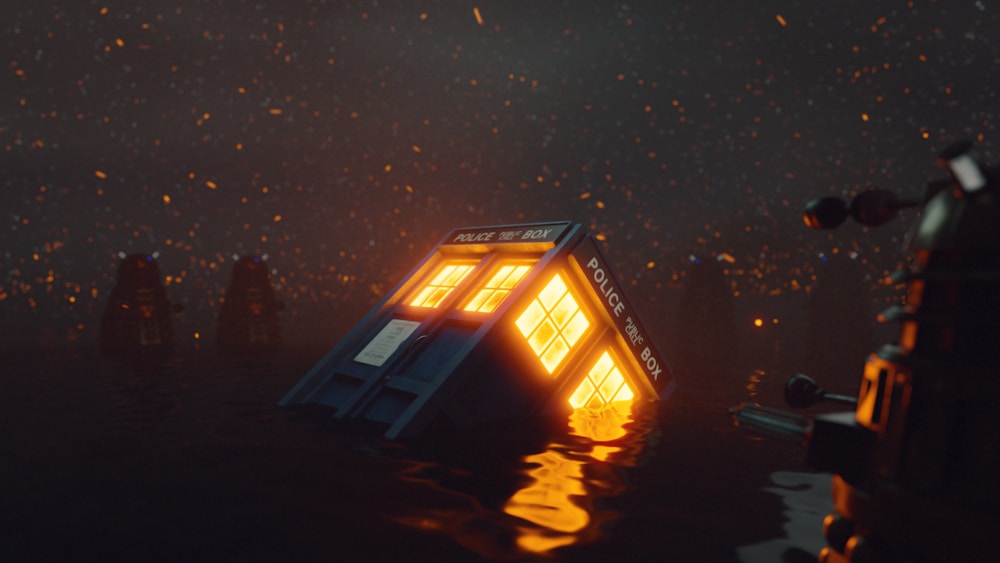
Gail Simone shared a small, sad story that comic readers know too well.
She said she was asked to write for Doctor Who. She had a fun pitch. She wanted a Dalek version of K-9. A metal dog meets a metal pepper pot. It is silly in the best way.
Then the deal hit a wall.
Simone said it “can’t really be done” because the rights to the Daleks and the rights to K-9 are owned by different people. In her words How to Change a Tire, that “put the kibosh” on the story.
That one post is a tiny window into a much bigger thing. Doctor Who is not just a TV show. It is also a long-running patchwork of contracts, old deals, new deals, and “we can use this, but not that” rules.
And the odd part is this: the mess is not a bug. It is part of the history.
A great idea can die on one line of legal text
When we read comics, we picture a writer at a desk. They dream up monsters, jokes, big set pieces, and sweet moments.
But a licensed comic has another writer in the room.
It is the contract.
A licensed book can only use what the license covers. Even inside one brand. Even inside one “universe.” Even inside one show. How Many Ounces in a Pound?
If you mix two famous pieces, you may be making a brand-new thing that is owned by two different owners at the same time. That is not “just a crossover.” It is a legal knot.
A Dalek K-9 is not only a joke. It is a mash-up. It is a new design idea. It also pulls on two sets of rights at once.
So the answer can be simple and brutal: no.
Why Doctor Who is extra complicated
A lot of modern TV is built on “work for hire.” The company owns what gets made. The writer gets paid, and that is that.
Classic Doctor Who did not always work that way.
For years, the BBC used freelance writers. Many of those writers kept rights to the characters and ideas they created. Over time, that left a trail of “outside” ownership sitting inside the show.
So the BBC might own the show and the name and the TARDIS.
But another person might own a monster. Or a robot dog. Or a villain race. Or a key idea that fans treat as part of the furniture.
That is how you end up with a strange sentence that is still true decades later:
The BBC can make Doctor Who, but it still may need permission to use some Doctor Who things.
The Daleks: the most famous “not fully ours” monster
The Daleks are the biggest example, How Many Ounces in a Gallon because they are so central.
In 2004, as the BBC was gearing up to bring Doctor Who back, a public rights fight broke out. Reports said the BBC could not agree terms with the estate of Dalek creator Terry Nation. The estate wanted a level of editorial control the BBC would not give. The result, at that moment, was simple: the new show would have no Daleks.
Not long after, the story flipped. The BBC confirmed the Daleks would appear after all, saying the “artistic differences” had been resolved and that an agreement was reached with Nation’s estate.
That quick swing is the point.
Daleks are not just a writing choice. They are also a rights choice.
When the “Plan B” monster is already on the shelf
When the Daleks were in doubt in mid-2004, the production team still had to plan a season. Scripts still had to be written. Monsters still had to exist.
So a backup idea came into being.
Later reporting on Russell T Davies’s writing process noted that the Toclafane were first conceptualised in July 2004 as an alternative option if the Daleks could not be used.
That matters for two reasons.
First, it shows how early rights problems can shape story. Not as a small edit. As a core building block.
Second, it shows how creative teams cope. They build extra doors in the hallway. They keep spare keys. They design monsters that can carry the same story weight if the big icon is locked away.
So when someone says, “It can’t be done,” Begonia, Escargot that does not mean writers lack imagination.
It means the keys do not fit.
K-9: a beloved robot dog with split ownership
K-9 feels like pure Doctor Who. He is a companion. He is in the canon. He is in the memories of a whole generation.
But K-9 has his own rights story.
K-9 was co-created by writer Bob Baker (with Dave Martin) and first appeared in 1977. Over the years, the character’s rights and the BBC’s rights over the look of the prop have been discussed in public in the context of spin-offs and redesigns. In the Australian-made K9 TV series, for example, the show used a noticeably different K-9 design, and reporting around the series notes that this was because the BBC owned the original K-9 design while Baker held rights to the character.
So K-9 is a perfect match for Simone’s claim.
Even when a character “belongs” to a franchise in the way fans feel it does, ownership can still be split.
And “split” changes everything when you try to combine characters.
Why a Dalek K-9 is not the same as “Daleks + K-9 in one panel”
It helps to slow down and say what Simone’s idea really is.
A Dalek K-9 is not just K-9 standing next to a Dalek.
It is a hybrid.
That means:
- You are taking the Dalek look, and the Dalek concept.
- You are taking K-9 as a character concept.
- You are building a new “version” of K-9 using Dalek parts.
That can create a new work that is “derived” from both. It can trigger approval from both owners. It can also trigger brand rules from both owners Bougainvillea ‘California Gold’.
Even if you can license Daleks.
Even if you can license K-9.
You still might not be allowed to fuse them.
One side might say yes and the other might say no.
Or both might say “yes, but only with heavy rules.”
Or the cost might jump to a level that makes no sense for one comic story.
So a story can die before it is even outlined.
Not because it is bad.
Because it is tangled.
Titan Comics, modern Doctor Who comics, and why this likely came up now
Simone did not name the publisher in her post, but the context around the current Doctor Who comic line points to Titan Comics.
Titan has been publishing licensed Doctor Who comics for years. It has also been running new material tied to the Fifteenth Doctor era, and it has released special projects tied to earlier Doctors.
Titan’s own listing for Doctor Who: Once Upon A Time Lord shows it as a 64-page collection written by Dan Slott, centered on the Tenth Doctor and Martha Jones.
Coverage of Titan’s Free Comic Book Day launch for Doctor Who: The Fifteenth Doctor also points to Dan Watters as the writer for that new era line.
So the timing fits. Titan is active. The line is alive. There is room for guest writers. There is also a lot of rights math behind the scenes.
That is the kind of place where a pitch can be loved in a meeting Caladium, Dang Koei Chai, then quietly stopped when the legal review starts.
The hidden cost: stories you never get to read
The loss here is not only one goofy visual.
When rights block a story, we lose a whole chain of possible scenes.
- How does the Doctor react to a friend being “Dalek-ified”?
- Does K-9 keep his voice and manners?
- Does he say “Affirmative” in a Dalek bark?
- Does the Dalek side glitch when he tries to be a good dog?
Even if the tone is light, the emotional core is real. K-9 is loyal. Daleks are not. That contrast is story fuel.
And it is gone. Not for story reasons. For ownership reasons.
That is the part fans feel, even if they never see the paperwork.
Why Doctor Who keeps running into these walls
It is easy to think this is rare. It is not.
Doctor Who has a long history. It also has a long list of creators. Over decades, contracts changed. The BBC’s policies changed. UK TV norms changed.
So you get a universe where:
- Some things are owned fully by the BBC.
- Some things are jointly controlled.
- Some things require permission.
- Some things can be licensed outside the BBC under certain terms.
That is why you have seen odd side projects over the years. Sometimes a character can appear in a non-BBC project, but only in a changed form. Sometimes a monster can be used, but only with a different Calathea lancifolia, Rattlesnake Plant backstory. Sometimes a character can be referenced, but not shown.
This is not always about greed. Sometimes it is just the natural result of old deals.
But the end effect is the same for us.
A writer’s imagination meets a locked door.
Why we keep seeing the Daleks so often
There is also a practical side. If a brand icon is hard to use, a show might use it less.
But with the Daleks, the opposite often happens.
Once the Daleks are cleared for use, they are a sure thing. They sell. They are a marketing hook. They are a “big bad” that needs no intro.
So even if a story could work without them, the Daleks keep coming back.
And because Dalek rights have been public news before, the show has also learned to plan around them. The creative team can write episodes that use Daleks in big ways, small ways, or quick cameos, depending on what is possible and what is needed.
That same planning instinct is what we saw in 2004, when the Daleks looked like they might be out, and the team still had to build a season anyway.
What writers do when the toys are locked
Comics writers who work on licensed books learn a special skill.
They learn to love the parts they are allowed to touch.
If you cannot use the Daleks, you build a new threat.
If you cannot use K-9, you build a new robot friend.
If you cannot fuse two icons, you build a different joke. You keep the spirit.
Sometimes the “restriction” even becomes a creative push. It forces you to invent.
And sometimes it just stings.
Because the simple truth is this: some of the best ideas are the ones that break the rules a little. They remix the familiar Calibrachoa, Cabaret Blue. They twist it. They show it in a new light.
Rights rules often exist to stop that twist.
Not because the twist is bad.
Because the twist is risky.
Where This Leaves The TARDIS
Simone’s story feels small. It is one pitch that did not happen.
But it points at the big shape of Doctor Who as a creative machine.
This franchise has always been made by many hands. That is part of its charm. It changes. It regenerates. It stays weird.
The rights history is the shadow side of that same fact.
Many hands made it.
So many hands still hold pieces.
That is why a Dalek can be cleared, but a Dalek K-9 can be blocked.
That is why we can get a new comic run with a new Doctor, but still lose a single fun panel idea.
And that is why, in Doctor Who, even the monsters have paperwork.