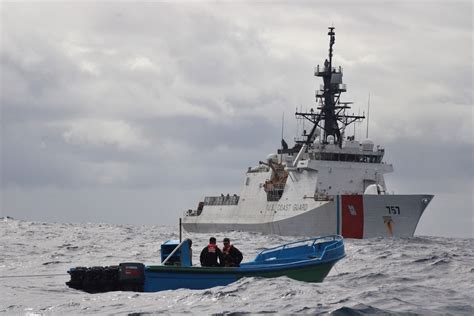
A U.S. Coast Guard ship made a huge drug bust at sea. The cutter Munro stopped a fast boat in the East Pacific on December 2, 2025. Its crew seized 22,052 pounds of cocaine. Six suspects were held.
The Coast Guard said the load was worth more than $250 million. It was the service’s largest single drug seizure at sea in 18 years. The case also showed how ships, small boats, drones, and a helicopter can work as one team.
What Happened at Sea
Munro was in the East Pacific for Operation Pacific Viper. The Coast Guard began the push in August 2025. It sent more ships, planes, and crews to key drug routes.
Munro found a fast boat on a known route. The crew used two small pursuit boats, a ScanEagle drone, and an MH-65 helicopter. The helicopter first fired warning shots. It then fired at the boat’s engines to make it stop.
Coast Guard teams then boarded the boat. They took six suspects into custody and seized the cocaine.
The Coast Guard later gave the final weight as 22,052 pounds. That is more than 11 tons. It was the largest single Coast Guard drug bust at sea since 2007. The Coast Guard’s March 6, 2026 patrol report gives the full account.
Pacific Viper Grew Fast
This was not one lone bust. It was part of a much larger push.
By October 14, 2025, the Coast Guard said the effort had seized more than 100,000 pounds of cocaine. By December 9, the total was above 150,000 pounds. By February 5, 2026, it was above 200,000 pounds.
Those totals show how much cocaine moves by sea. They also show why one big bust does not end the trade. Drug groups can change boats, routes, crews, and times.
The Coast Guard is the main U.S. agency for drug stops at sea. Its crews work with other U.S. teams and with foreign partners.
Why the East Pacific Matters
The East Pacific is a key route for cocaine from South and Central America. It is a vast area. A small fast boat can be hard to find.
Smugglers use fast boats, fishing boats, and low craft that sit close to the water. Some boats have no clear flag. Some crews pass a load to a new boat before it gets near the United States.
That is why drones and planes help. A cutter can cover a lot of sea, but it still needs eyes past the horizon.
Our report on two survivors held after a strike on an alleged Venezuelan cartel boat shows a very different kind of drug mission. It also helps show why a Coast Guard stop and a military strike can raise different legal issues.
How Munro Stopped the Boat
The Munro case used a law enforcement plan. The goal was to stop the boat, hold the crew, and keep the drugs as proof.
HITRON crews train for fast boats that will not stop. They can fire warning shots. If a boat still runs, a trained marksman can fire at its engines.
That is what happened here. The engine fire stopped the boat. Small Coast Guard boats then moved in.
This method can be risky. Still, it can let crews make an arrest and save proof for court.
Our guide to Pam Bondi’s time as attorney general gives more context on federal law enforcement in 2025 and 2026. The Coast Guard has its own power at sea, but big drug cases can involve many U.S. agencies once a ship reaches port.
What the Bust Means at Home
The clearest fact is simple. This load did not move on to its next stop. Drug groups lost cargo, time, a boat, and crew members. U.S. teams also gained proof and may have gained new facts about the group behind the load.
The wider drug crisis is harder to solve. Cocaine can harm or kill. It can also be mixed with fentanyl. Sea patrols can cut some supply, but care, health work, local police, and drug education still matter.
For a wider look at how the U.S. framed threats at the time, see our guide to the U.S. National Security Strategy. Drug crime was one part of a much larger set of border and security issues.
Force at Sea
A Coast Guard boarding is not the same as a military strike.
Coast Guard crews are trained to stop boats, arrest suspects, and keep proof. A military attack may use a different legal basis and a different set of rules.
That became a key debate in 2025. Some people backed stronger force against cartels. Others asked what law allowed each strike and how targets were chosen.
The Munro case is a clear example of the Coast Guard model. The boat was stopped. The suspects lived and were held. The drugs were seized. The proof could be kept for court.
Life on Munro
Munro is a Legend-class National Security Cutter. It can stay at sea for long trips. It can carry a helicopter, drones, and fast small boats.
That gear gives the crew many ways to find and stop a suspect boat. The ship can also do other work.
Noah’s Outdoors has a useful guide on how hunting and fishing rules are enforced. The topic is not drug crime, but it gives a simple look at how officers apply laws in the field.
If you spend time on boats, a waterproof dry bag can help keep a phone, maps, and spare clothes dry. A small marine first-aid kit can also be useful for boat and shore trips.
What We Know Now
The Coast Guard gave a fuller report on March 6, 2026. It said Munro had been at sea for 119 days and had traveled more than 26,000 miles.
That report also confirmed the December 2 drug stop and the final 22,052-pound weight.
The same trip later took Munro from the Pacific to the Atlantic. That shows how one large cutter can shift from drug work to other U.S. missions.
Why This Bust Still Matters
The Munro bust did not end cocaine smuggling. No one bust can do that.
It did remove more than 11 tons of cocaine from a major sea route. It also showed how the Coast Guard can use a drone, a helicopter, small boats, and a large cutter in one stop.
That is the main story. Crews had to find a small boat on a huge ocean. They had to stop it, board it, hold the suspects, save the drugs as proof, and move the case into the U.S. legal system.
That work led to one of the largest Coast Guard cocaine seizures at sea in recent history.