A U.S. Coast Guard cutter, the Munro, just pulled off something huge in the Eastern Pacific.
In one operation, its crew took more than 20,000 pounds of cocaine off a single smuggling boat — the largest at-sea drug seizure by the Coast Guard in nearly 20 years.
This wasn’t a quiet boarding.
It was part of Operation Pacific Viper, a hard-charging Trump administration campaign that pushes more ships, aircraft, drones, and elite boarding teams into the Pacific drug lanes.
From a U.S. point of view, this is more than a dramatic video clip.
It’s about overdose deaths at home, foreign cartels abroad, and how far we’re willing to go at sea to stop the flow in between.
In this article, we’ll walk through what happened, how the Coast Guard did it, why the Eastern Pacific matters so much in the drug trade, and what all of this means for communities across the United States.
What Exactly Happened on the Munro’s Patrol?
A “go-fast” boat loaded with cocaine
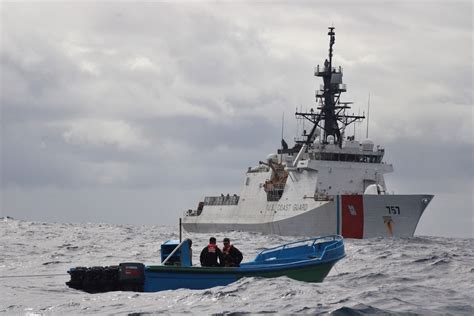
The seizure happened in the Eastern Pacific Ocean, a huge stretch of water between Central/South America and the U.S. West Coast. The Munro was on patrol when it tracked a suspected smuggling boat — a low, fast craft often called a “go-fast.”
On board that boat:
- More than 20,000 pounds of cocaine
- Packed in bales and bricks
- Worth hundreds of millions of dollars on the street
According to Coast Guard and Pentagon briefings, this single bust removed the equivalent of about 7.5 million potentially lethal doses from the supply chain.
A helicopter, a sniper, and precision shots
This was not a simple “pull alongside and ask to see the paperwork.”
The operation used:
- A Coast Guard helicopter from the Helicopter Interdiction Tactical Squadron (HITRON)
- A trained sniper firing from the air
- Precision shots to disable the boat’s engines, forcing it to stop
Once the engines were dead, small boats from the Munro closed in. Boarding teams in body armor climbed aboard, secured the smugglers, and began counting the bales.
This is the kind of high-risk mission the Coast Guard has been refining for years — mixing military-style tactics with law-enforcement authority.
Operation Pacific Viper: The Big Picture
A surge in the Eastern Pacific
Operation Pacific Viper is a surge campaign in the Eastern Pacific that began in August 2025. It throws extra cutters, aircraft, drones, and tactical teams into one of the world’s busiest cocaine highways.
Since the operation began, the Coast Guard reports:
- Over 75,000 pounds of cocaine seized in the first weeks
- Over 100,000 pounds seized a month later, from 34 interdictions and 86 suspected traffickers
- Nearly 510,000 pounds of cocaine interdicted across fiscal year 2025 — the highest in Coast Guard history
The Munro’s 20,000-plus-pound haul is a single, record-setting piece of that larger campaign.
A Trump-era “war on narco-terrorism”
The Trump administration is branding Pacific Viper as part of a wider “war on narco-terrorism.”
Key steps include:
- Designating major cartels, like Sinaloa and the Venezuela-linked group Tren de Aragua, as foreign terrorist organizations
- Using military tools — including drone strikes and airstrikes on suspected smuggling vessels — alongside traditional Coast Guard interdictions
- Surging more National Security Cutters like Munro and Stone into the Eastern Pacific
That mix has produced record seizures — and serious debate about how far the U.S. should go in using force at sea.
Why the Eastern Pacific Matters So Much
The “highway” from South America to U.S. streets
Most of the cocaine that reaches U.S. cities starts in Colombia, Peru, or Bolivia. From jungle labs, it moves to hidden coastal sites, then onto:
- Go-fast boats
- Fishing vessels
- Semi-submersible “narco-subs”
These boats often head north and west into the Pacific, hugging the coasts of Ecuador, Colombia, and Central America. From there, they dump loads onto other boats or small planes, which move the drugs to Mexico and then across the U.S. border.
The Eastern Pacific is so busy because:
- It’s huge and hard to patrol
- Smugglers can switch routes quickly
- Many vessels are “stateless” — they don’t fly a clear national flag, which can make enforcement tricky
A long history of big busts
This new Munro seizure joins a long list of giant cocaine hauls at sea:
- In 2019, federal agents seized nearly 40,000 pounds of cocaine from a ship in Philadelphia — the biggest land-side cocaine bust in U.S. history
- In 2007, Coast Guard cutters Hamilton and Sherman helped seize 20 tons of cocaine from the freighter Gatun off Panama — at the time, the largest maritime seizure ever
- Earlier in 2025, another cutter, Stone, grabbed 49,000 pounds of cocaine in a single deployment, with help from a high-tech drone.
The difference now is the pace. With Pacific Viper, the Coast Guard is seizing thousands of pounds per day on average.
Meet the Munro: The Coast Guard’s Heavy Hitter
A modern “Legend-class” ship
USCGC Munro is a Legend-class National Security Cutter, one of the most capable ships in the Coast Guard fleet.
It carries:
- A flight deck and hangar for helicopters and drones
- High-speed small boats for boarding
- Powerful radar and sensors
- A crew trained for both combat-style operations and law enforcement
Munro has a track record. In 2019, its crew boarded a semi-submersible loaded with 17,000 pounds of cocaine, a dramatic takedown that went viral when video showed Coasties jumping on the moving sub and pounding on the hatch. (Wikipedia)
The new 20,000-plus-pound seizure builds on that reputation.
Coast Guard life: long patrols, big stakes
From a U.S. perspective, it’s easy to see headlines and forget the human side.
For the crew, this kind of mission means:
- Weeks or months at sea
- Long watches on the bridge or in the engine room
- Flying at night in rough weather
- Boarding unknown boats where smugglers may be armed or desperate
Yet these patrols are a core part of the Coast Guard’s identity — a blend of military service, policing, and rescue work that supports both homeland security and global stability.
How Big Drug Busts Connect to Life Back Home
Turning tons of cocaine into real-world impact
Twenty thousand pounds is a huge number. It can help to picture what that means for American communities.
According to Coast Guard and law-enforcement estimates, that load could be cut, mixed, and sold into millions of individual doses.
Fewer shipments making it through can mean:
- Less cocaine available in U.S. cities
- Higher costs for traffickers, which can disrupt networks
- More pressure on cartels as they lose money and boats
Of course, no single bust “wins” the drug war. The cartels will try new routes, different methods, and other markets. But from a U.S. point of view, every large seizure:
- Buys time
- Forces the enemy to adapt
- Reduces the flow of drugs that can be mixed with fentanyl, which fuels many overdose deaths today
The overdose crisis at home
The U.S. is still dealing with a deadly overdose crisis, driven mainly by synthetic opioids like fentanyl. But cocaine is often part of the picture, especially when it is secretly mixed with fentanyl or used alongside other drugs.
Cutting a load of this size out of the pipeline doesn’t solve the problem, but it removes a huge volume of potential poison from the system.
For families who have already lost loved ones, it can feel like too little, too late. For those working in public health, every reduction in supply can still help — especially when paired with better treatment, prevention, and education at home.
The Legal and Moral Debate Around “Hard Power” at Sea
Coast Guard vs. military strikes
Not every drug bust under Pacific Viper has looked like the Munro’s operation.
Some missions have involved military airstrikes on suspected smuggling boats, followed by a second strike when survivors tried to escape. A recent briefing to lawmakers revealed one case where traffickers who survived the first strike were killed hours later in a second attack — and the drugs were reportedly bound for Suriname, not the United States.
That raised questions in Congress and among legal experts about:
- The rules for lethal force
- The limits of self-defense at sea
- Whether labeling cartels as “terrorists” changes what the U.S. can lawfully do
Against that backdrop, Coast Guard interdictions like the Munro’s stand out. They show that it is still possible to stop a smuggling boat, arrest suspects, and seize drugs without blowing the vessel out of the water.
A U.S. balance to consider
From a U.S. viewpoint, the balance looks like this:
- We want to protect our communities from drugs
- We want to hit cartels hard so trafficking becomes more risky and less profitable
- We also want to respect the laws of war, human rights, and our own values
Operations like Pacific Viper sit right on that line. Supporters see them as a long-overdue show of strength. Critics worry about mission creep, blurred legal lines, and the risk of killing people far from any declared battlefield.
The Munro’s seizure gives both sides a case study: a massive win against traffickers, carried out with tight rules of engagement and clear law-enforcement authority.
What Comes Next for Pacific Viper and the Coast Guard
More tech, more cutters, more pressure
Looking ahead, the U.S. is likely to keep leaning into three things:
- High-end ships and crews
- National Security Cutters like Munro, Stone, Midgett, and others
- Medium-endurance cutters such as Tampa and Seneca, which have also been busy under Pacific Viper
- Drones and advanced sensors
- Drones like the MQ-35 V-BAT give cutters long-range eyes at night and in bad weather, helping them find smugglers before they disappear into the horizon.
- Closer partnerships
- Working with Latin American navies and coast guards
- Sharing intelligence and radar tracks
- Coordinating with U.S. agencies like DEA, CBP, SOUTHCOM, and the Navy
As long as cocaine demand and cartel profits stay high, the U.S. will keep facing pressure to maintain — or even expand — this maritime front line.
Questions Americans will keep asking
Even if we support tough action at sea, we still face big questions at home:
- Are record seizures a sign that we are winning, or proof that the overall flow is still massive?
- How much money and risk should we place on far-away waters vs. treatment, policing, and community work at home?
- Can we push operations like Pacific Viper hard without sliding into a permanent shadow war at sea?
Those questions don’t have simple answers. But they hang in the background of every big bust, including the Munro’s.
Why This One Bust Still Matters Tomorrow
From the deck of a cutter in rough Pacific seas, the mission is clear.
Stop the boat. Save the evidence. Bring the smugglers in alive.
From the shore, things look more complicated.
This single bust will not end cartel power. It will not stop all cocaine from reaching U.S. cities. It will not bring back those we’ve already lost to overdoses.
But from a U.S. perspective, the Munro’s 20,000-pound seizure still matters in real ways:
- It strips millions of dollars from violent criminal groups
- It shows that precision law enforcement at sea can work
- It backs up U.S. promises to push back against narco-terror networks
- It reminds us that the overdose crisis is tied not only to what happens in our neighborhoods, but also to battles fought hundreds of miles from any coast
As Operation Pacific Viper rolls on, the Munro’s crew will likely head out again.
New boats will be tracked. New loads will be seized. Some will slip through.
For now, though, one narco-boat is sitting empty, its engines shot out, its deck cleared of bales, its crew in custody — and more than 20,000 pounds of cocaine will never reach American streets.
That is a win worth noticing, even as we keep pushing for deeper answers to the drug crisis at home.